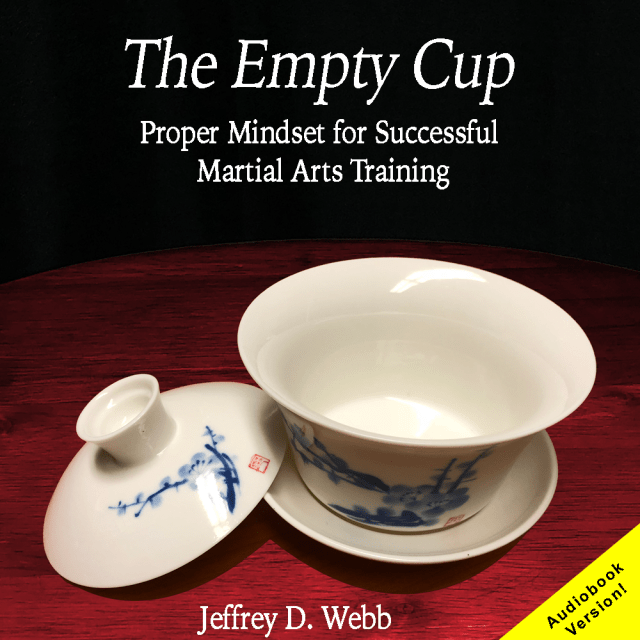
The Empty Cup is the title of a book I published last year which provides readers with the eight keys to developing a proper mindset for success in their martial arts training. Presented in the form of parables, these life lessons are analyzed and explained in a way that is easy to understand and apply.
But beyond it’s applicability to martial arts training, these principles can be applied to learning just about anything. As one of the reviewers of my book said, “The subtitle of this book is ‘Proper Mindset for Successful Martial Arts Training’ but really it is the proper mindset for learning really anything in life. Starting with approaching any subject with an open mind and be willing to learn from the newest person in the building or the oldest person in the room; each person can offer something new to help you on your journey either in Martial Arts, biking, programming, or writing a book – any subject where you are wanting to learn.“
The book begins with and takes its title from the parable of the Empty Cup, a well-known concept in Chinese martial arts. Having an empty cup means entering a learning situation as an open vessel, fully prepared and anxious to absorb new knowledge. Only by having an open mind and a beginner’s curiosity to learn can we allow ourselves the opportunity to take in new information without prejudices or preconceived notions limiting us from giving fair consideration to the new material we are being taught.
So beginning with that, I encourage you to pick up a copy of The Empty Cup which is available in both paperback and Kindle format. This blog is meant to accompany the book, as well as my future book projects and it is my hope that readers will take something of value from The Empty Cup which they can apply to their everyday lives.
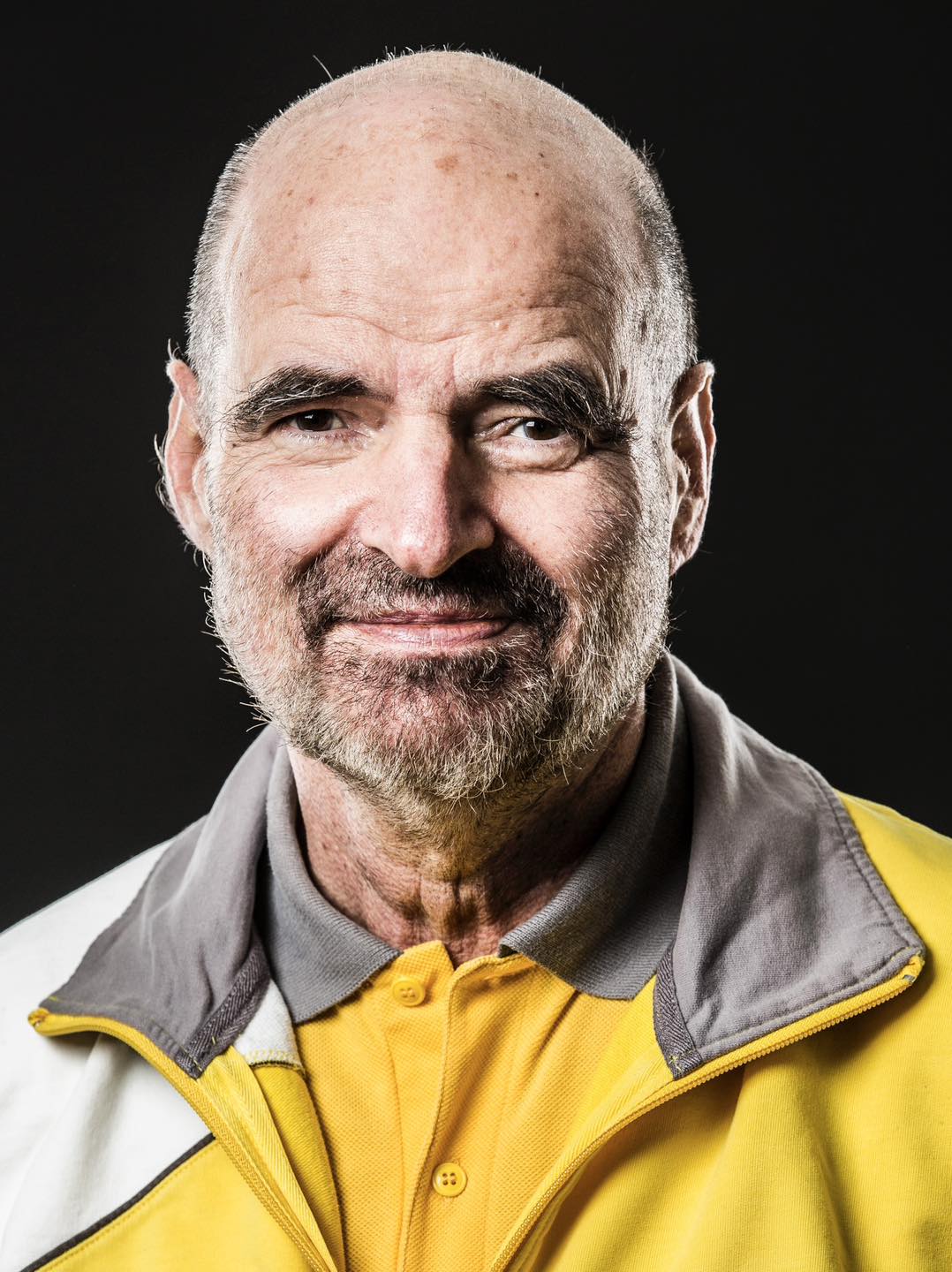
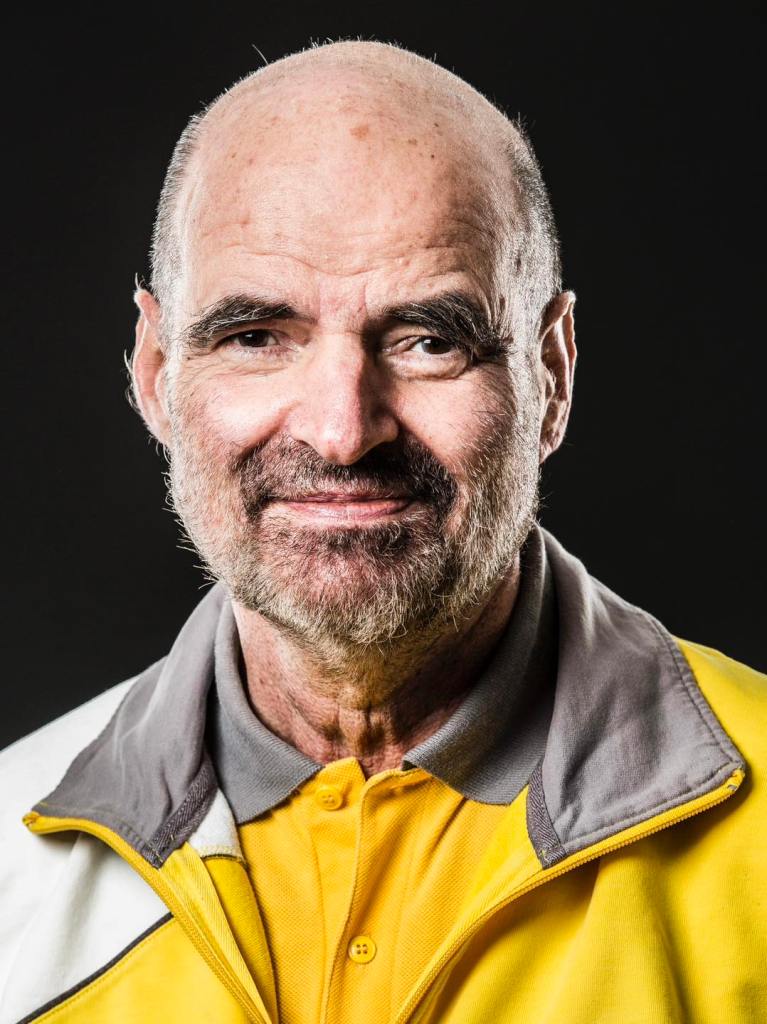
Two days ago on November 25, 2024, Grandmaster Keith R. Kernspecht, the pioneer of Wing Tsun kungfu in Europe passed away at the age of 79. To those who didn’t know him, one would assume that the death of ”a man in his seventies” meant he had spent his final years inactive and sedentary, but this was certainly not the case.
Quite the contrary, his final months were lived as he had lived his entire life – constantly traveling and teaching kungfu. And when I say constantly, this is not an exaggeration. One only needs to visit his FaceBook page to see current videos of him working with students, many of them larger than him, and all of them younger than him across the European Wing Tsun Organization.
These videos show a man of health, vigor, and an extraordinary level of martial skill handily dealing with persons of size, and athleticism by his use of technique, leverage, skill, and tactile reflexes.
He was in every sense an Üֹbermensch, someone who achieved that which is “beyond” what most ordinary men achieve. Yet he always remained a true Mentsch – a person of honor and integrity. Without a doubt, he always had a passion to build up others by educating, training, teaching, inspiring and motivating them to exceed not only their own limitations, but also their own imaginations.
I haven’t posted to this Blog in some time, so it is fitting to take this opportunity to honor of my departed friend. Let me share with you the story of how I met GM Keith Kernspecht for the first time and the lifelong impact he has made on my life as he has on so many others.
For 32 years Keith Ronald Kernspecht, the man dubbed as “The Kaiser of Kung Fu,” by Black Belt magazine, would be an inspiration, a mentor, a wise counsel, and above all a beloved friend to me. Though we were kungfu brothers, he was the same age as my own father. A few years back my father accompanied me on a trip to Italy where he and GM Kernspecht had a chance to meet. Both being from that same generation who grew up in the aftermath of WWII, GM Kernspecht and my father got along well. After sharing dinner and a long conversation with him, my father told me, “I really like Keith, he is an amazing man and I can tell he loves you like a son.”
I first met Sifu Keith Kernspecht on May 16, 1992 at a seminar he held in Saarbrücken, Germany. Having enlisted in the U.S. Air Force in 1991, I was later stationed at Ramstein Airbase, Germany following my boot camp and technical training.
I can say wholeheartedly that enlisting in the U.S. Air Force was one of the most consequential decisions of my life. Not only because it shaped my formative years, but because it caused me to cross paths with GM Kernspecht. Looking back, my life would have been vastly different had I not met him.
Though I had trained in Wing Tsun kungfu since 1985, there were perhaps only 15+ schools spread across the entire United States. In Germany on the other hand, there were close to 400 schools at that time which had been established through the efforts of GM Kernspecht and his EWTO. This does not include the other branches of his organization throughout the European continent. Naturally the standard of instruction was very high and coming from a comparatively tiny organization in the USA, it was literally a dream come true for me.
Shortly after arriving in country, I made contact with a local instructor named Jörg Weber who ran a chain of around 6 training groups in the area. Within less than two weeks, I was accompanying him and his students to Saarbrücken for a seminar with then Master Kernspect. For the next 3 and 1/2 years, I would attend these quarterly seminars, as well as special annual events in Wiesenbach without fail. The only exception being the one time I had a severe flu.
Each local seminar would typically begin with GM Kernspecht breaking the mass of participants into smaller groups based on rank and showing each group what to start working on. For the remainder of the time, he would constantly rotate, moving from one group to the next to give them individual instruction. At the time, I marveled at how he tirelessly went from group to group, again and again, practically without a break. Naturally with such large numbers of participants, often 200 or more, there were other instructors on hand to assist with the instruction as he cycled through the groups.
Upon arriving at our group, Jörg Weber walked me over to GM Kernspecht and formally introduced me. Before leaving the USA, I had actually written a letter to GM Kernspecht introducing myself and telling him I was an American student of Grandmaster Leung Ting who would be stationed in Germany that May.
He remembered and greeted me warmly, then we chatted for a while. As things turned out, we had the same Si-Fu (GM Leung Ting) which created an interesting situation. In Germany GM Kernspecht was the only direct student of GM Leung Ting, which made me his Si-Dai (younger kungfu brother). Everyone else in Germany was either his To-Dai (direct student), or a student of one of his own students. I remember this initially caused some confusion with others around me, because I addressed him as Si-Hing (older kungfu brother) and not Si-Fu (kungfu father) or Si-Kung (kungfu grandfather) as everyone else in Germany did. This coupled with me being “the American,” initially made me stand out.
Well as we spoke, I let him know that I would be stationed in Germany for at least three years and had the goal of learning as much as I could in order to teach when I returned to America. He understood and explained to me that though the forms, basic lat-sau and chi-sau training were the same internationally, the EWTO student program was based heavily on the specific lat-sau fighting program which he had developed. Though I was Student Grade 11 (an assistant instructor rank), I would need to learn those EWTO programs before advancing and that Jörg would see to my on-going training locally.
Previously, I had been exposed to the first three levels of this lat-sau program by a German instructor named Thomas Dolnitzki who had visited the USA in the late 1980’s. GM Kernspecht was aware of this and told me, “So Jeff, you are free to go to whichever group you think you belong and start there.” Humbly, I opted for the group at Student Grade 4.
After training with that group for some time, we were instructed to begin practicing Wing Tsun’s second empty-hand form known as Chum-Kiu. At one point that afternoon, GM Kernspecht walked over with Sifu Thomas Mannes, the head instructor of that area and watched me performing the form. As they were discussing, I remember GM Kernspecht telling Sifu Mannes in German, “Ein schöne Chum-Kiu,” (meaning a nice looking Chum-Kiu performance).
What happened next took me totally by surprise…GM Kernspecht walked over to me, pulled me aside, called the group to gather round, gave them a quick explanation and then began to walk away.
At this point I was standing in front of a group of about 20-25 strangers that I had been practicing with – all staring at me. Though I had learned some German before arriving in country, I didn’t fully understand what he had just announced to them. So before he walked off I said, “Excuse me, Sir. I’m sorry, I didn’t understand what you told them,” to which GM Kernspecht replied, “Oh, I told them your Chum-Kiu form looks just like GM Leung Ting’s and that you would be leading the form for them,” then he just smiled and walked away. Wow. For a moment I was in shock, but being freshly out of military boot camp, I simply did what I was told to do. I lined everyone up and began leading them through the form.
I continued doing this for the remainder of that portion of the seminar, leading them in unison to perform Chum-Kiu, then making corrections on students while trying to speak to them in broken German. Though many younger Germans spoke some English, the only language we really had in common was Wing Tsun itself.
This was my first impression of GM Kernspecht which revealed something about his character, something which I believe made him such an exceptional leader. He had an uncanny ability to read people and bring out the leadership abilities within them. It didn’t matter whether you could see these things within yourself, he could see them and knew how to encourage them.
Here I was a young assistant instructor with little experience, a foreigner with barely a rudimentary grasp of their language, put in front of a large group of people and told to lead them. Was I nervous? Yes, absolutely! But it was a test of my character, and an opportunity to groom a young instructor in the making.
Gratefully, this became the first of many occasions over the years where GM Kernspecht helped me grow in my confidence by confronting my own limitations. One of many opportunities to face something daunting and learn to overcome it.
Interestingly, it was just two years later in 1994, that an almost identical opportunity arose. By this time I was a Primary Level (1st degree) instructor and was now fairly fluent in German. As luck would have it, I was given a “progress check” of sorts by GM Kernspecht…
October 1993: Promotion to Primary Level, Wiesenbach, Germany.
One weekend in early 1994, a couple of my training partners and I decided to drive to Frankfurt for a seminar with GM Kernspecht for some extra training. At that time, the Frankfurt group was rather huge and that particular seminar was broken down into one day for the students and another day for the instructor levels.
Well, we inadvertently arrived on the day scheduled for the younger students. Since it was a bit of a drive, each of us decided to just go ahead and stay. Surprised but happy to see me, GM Kernspecht’s response was, “Well then, you‘ll just have to assist me in teaching the beginners.” Once again I was tasked to lead a group learning the Chum-Kiu form. Hmm…
This time however there were over 50 students, but I was more than confident the handle this task. Looking back, GM Kernspecht surely remembered putting me in this same situation just two years earlier. No longer was I the foreigner who could barely speak German, and inexperienced at teaching groups. Now I was a well-trained instructor, fluent in the language, and confident in myself. Truly, this was one of my fondest memories of my time in Germany and I can’t express how proud I was each time he passed by the group and gave me an approving nod while I was teaching.
For over the next three decades he would continue to have a significant impact on my development as a teacher and leader in a number of ways. From 2001 to 2007, I ended up leading the American organization, a challenging task under the rather mercurial direction of my former teacher GM Leung Ting.
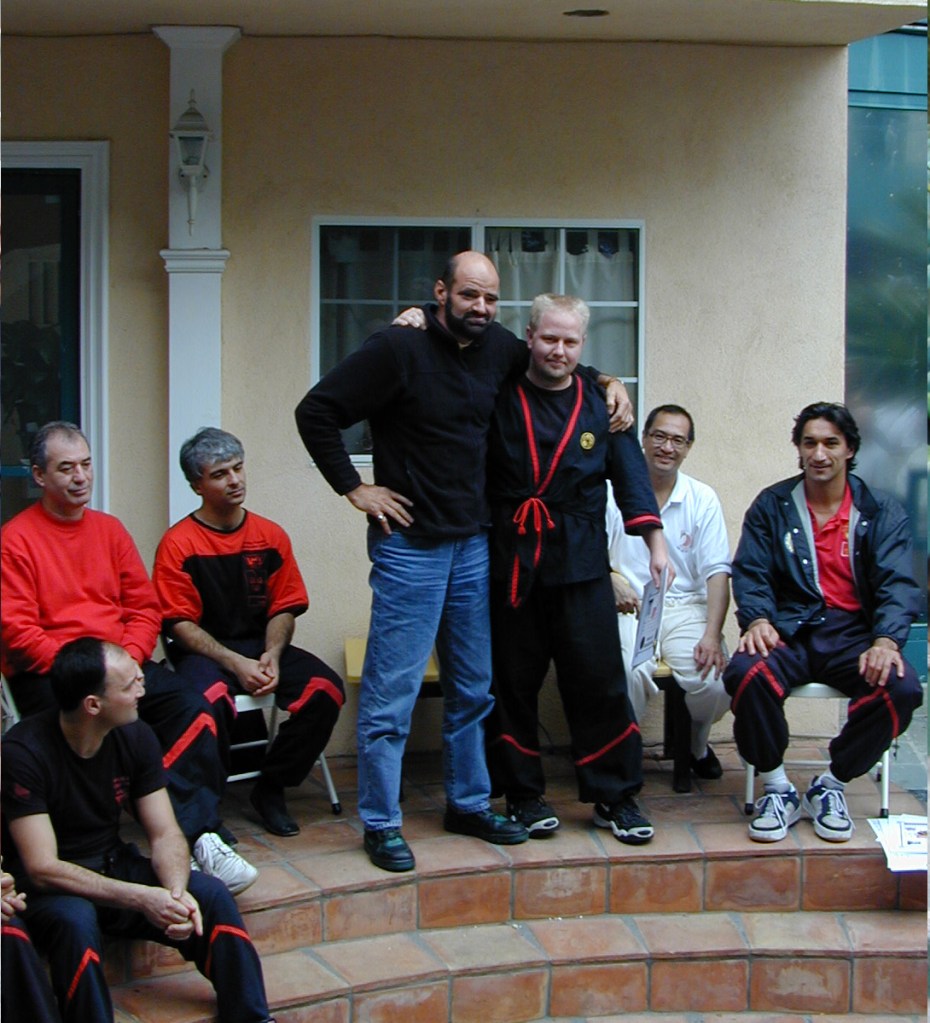
January 2000: Promotion to Third Level, Los Angeles, California.
January 2000: Testing for Third Level, Los Angeles, California.
But GM Kernspecht who had years of experience dealing with this himself was always an invaluable source of support and advice for me throughout that period. Even afterwards, when I chose to leave the IWTA and form my own National Ving Tsun Organization, GM Kernspecht continued to offer his advice and support, as well as his continuing instruction to me, for which I was always grateful.
In closing, we are all still trying to process the incalculable loss of GM Kernspecht. All who knew him are profoundly saddened by his untimely passing. Over the past two days, I’ve texted and spoken with colleagues of mine overseas whose lives he has personally touched. Close friends who many would consider “tough martial artists” have, like myself, all been brought to tears by his passing. He won’t be there at the next seminar, and we can’t just reach out via text or email anymore. He’s gone, and the world is a poorer place without him.
When one exceptional man has filled so many roles in the lives of so many others, such as Si-Fu, Si-Kung, Si-Hing, teacher, mentor, guide, role-model, life coach, motivator, leader, or even friend; it leaves an inevitable void.
But as I ponder mortality, his and our own, I am left realizing that he is not totally gone. For Keith R. Kernspecht has left us with two things: a lesson and a legacy. So as long as we remember and honor that, he will always be with us.
His lesson quite simply was his example: continue to work and improve, to strive for perfection, invest your time in others, guide them, mentor them, innovate, be a lifelong seeker of knowledge, think outside the box, ask yourself the hard questions, and above all be the kind of leader that inspires others to do the same.
But what of his legacy you ask? It’s each of us who knew him and learned from him. In us, his teachings will continue on. For each of us, has the same opportunity to inspire others and to help them experience the personal growth that he so passionately guided us to achieve. And in doing so, we can continue to experience that growth ourselves.
My prayers are thoughts are with my Wing Tsun family in Europe and especially with Sigi, Natalie, GM Bill, Giuseppe and Oliver. For my Si-Hing Keith, I wish you a good journey to the other side my friend. I will miss you, but we will see each other again some day. As always with love and respect, – Jeff
Among my friends there is one in particular that I think of when I hear the word “Warrior.”
My friend “M” (I use only an initial – out of respect for his privacy) is friendly and good-natured, but carries himself with an undeniable sense of confidence. Upon meeting him, you would agree that he seems both humble and comfortable with himself. From the martial arts perspective, one would say he is a very centered person. Like myself, he is under 6 feet tall and probably wouldn’t stand out in a crowd. Yet beneath this unassuming appearance, lays a rather profound individual.
You see, M is a retired Army Ranger. He is a combat veteran with numerous deployments around the globe, a recipient of the Purple Heart, and undoubtedly the most deadly accurate person with a handgun that I have met in my life. M is in every sense a warrior, a patriot, and a true hero. He always carries a knife and I have no doubt he is skilled with it. I’m pretty sure he can also handle himself empty-handed as well. Despite this, you’d never hear him give himself these accolades. People like M don’t have to tell you “I’m a warrior,” because they are…and they know it.
I’m starting this post with M’s story because it represents reality. I do so in order to contrast it with a disturbingly common fantasy that is prevalent in some areas of the martial arts community in America these days.
The fantasy in question, is the abundance of martial arts students running around describing themselves as “warriors” and even invoking the word “combat” when they describe their on the mat training experiences.
Case in point: recently one of my assistant instructors was discussing martial arts with a co-worker at his company. The co-worker, a guy in his 20’s who studies Brazilian Jiu-Jitsu, naturally felt his martial art was superior – which is his right. After all, if one didn’t believe in the martial art they were studying then it would be foolish to continue doing so, correct? However, when arguing the virtues of their different approaches (e.g. striking versus grappling), the co-worker became frustrated at one point and retorted, “you know nothing about combat!”
Upon hearing this, I just shook my head. Now I don’t know this fellow nor where he trains BJJ, but I would hope his instructor would slap him in the back of the head for making such a dumb comment.
Unfortunately this kind of wording has been bandied around quite a bit lately. While it probably makes good marketing for the schools who encourage these fantasies, it’s nonetheless as nauseating as it is delusional.
Still, it reminded me of a similar incident involving another friend of mine who is a life-long martial arts teacher, a military veteran, and another true hero. “D” (again, only using an initial out of respect for his privacy) is a former flight surgeon and combat medic. He too is a retired Army veteran with deployments to hot zones in Iraq, Afghanistan, and Kosovo where he administered trauma medicine on the battlefields, often while under fire and in austere conditions.
Well, a number of years ago, he related a similar story to me in which two younger fellows in MMA shorts walked into his school to inquire about lessons. At one point they questioned whether they would be required to wear “the funny pajamas” as their uniform and insisted they wouldn’t do so because, “we are warriors!” My friend D abruptly showed these two clowns the door, kicking them out of his dojo.
It’s comments like this that make people look really ridiculous, and show how out of touch they are with reality.
Before we go further, let me make one caveat… It would be different if the kind of people running around calling themselves “warriors” were actual professional fighters. By this I mean guys who train and fight for a living, not as a hobby. But this is not the case.
Going back to the discussion with my assistant instructor I suggested that the next time his co-worker (or anyone else for that matter) insists they are a warrior or that they are experts on the subject of combat, ask them these questions:
Have you ever served in the military? Were you a combat veteran or ever deployed to a combat zone?
Have you ever served in law enforcement? Did you ever have to go “hands-on” with a non-compliant suspect or employ pepper spray, baton, TASER or firearm in order to defend yourself?
Have you ever worked in private security / close protection / executive protection / bodyguard work? Have you ever had to go “hands-on” with a non-compliant adversary to defend yourself or protect your client? Have you ever had to use your firearm or other weapons on the job?
I see… So the person calling himself a warrior is actually just a hobbyist who practices a martial sport in his spare time. He does this a few hours per week in a padded, controlled and air-conditioned environment against his classmates who are also paying to be there.
Then he’s not really a warrior and he hasn’t really been in combat on a regular basis against non-compliant, aggressive individuals who might be trying to seriously injure or kill him.
Ah, therein lies the difference.
The thing that makes my friends M and D real warriors (though they would never call themselves as such…) is that they served professionally in a capacity where their lives were actually in danger – and they could have been killed numerous times. There was no “tapping out” if things went bad.
Practicing martial arts (regardless of the school or style) doesn’t make one a warrior. Concordantly, sparring with a classmate doesn’t constitute combat. While you may be learning and training a martial art; you’re not in the real world where warriors don’t get to choose:
The size, weight class, or experience level of their opponent.
The number of opponents they will encounter.
Where they fight (asphalt road, wet or filthy concrete floor, poorly-lit alley).
The weapons employed by the opponent (brass knuckles, a shiv, knife, ice pick, baseball bat, tire iron, firearm).
The presence of a referee to break-up the fight when one participant is incapacitated.
I would hope that words like warrior and combat be reserved for those to whom they apply and who deserve our respect and gratitude.
Is there virtue in being competent, formidable, and dangerous? Coming from a life spent in the martial arts, firearms, defensive tactics and as a military veteran, subconsciously I’ve always thought so. I must admit though, at times I wondered if this was something that only others with a background similar to mine could appreciate. That being said, though I’ve spent my life developing these skills, I never stopped to consider the philosophical reasons why this was true.
Over the past two years, the world has changed significantly. The political unrest, lockdowns, supply chain issues, cancel culture, defunding / defaming of law enforcement and the rioting by Antifa, BLM, and others have shown that our once safe United States of America is becoming progressively unsafe.
Instinctively, I have chafed against these changes because both I and my business have been affected by them. So a little over a year ago I made the decision to work in the field of private security; something I now do in addition to my career as a school owner and instructor. Due to my extensive background in the “hard skills,” and after several friends with military / law enforcement backgrounds prompted me, I decided to join them working for a local private security firm.
Naturally I approached this, as I do all new endeavors, with The Empty Cup mindset which has made it enjoyable, fulfilling, and profitable. In just one year I have clocked over 750 hours of experience working in a variety of venues. Sometimes in uniform, sometimes in plain clothes, sometimes wearing body armor, but at all times – being armed and dangerous.
After all, what purpose would it serve to employ someone as a private security specialist, bodyguard, or executive protection specialist if they were less formidable than the people you wanted to be protected from?
Still, it wasn’t until I came across an interview by Jordan Peterson that I sat down and personally considered why being dangerous was indeed a virtue. Peterson, a clinical psychologist, author and speaker from Canada, is considered a controversial figure in some circles and so naturally I wanted to hear what he had to say and judge it for myself.
The interview, conducted by noted journalist John Stossel, and located on YouTube, was simply amazing. Here, Mr. Peterson outlines why there is virtue in being dangerous. While on the surface this may sound primitive, barbaric, or even repulsive to some, his logic is nonetheless indisputable.
Several of the key-points which Peterson makes are:
Competent and dangerous are the alternatives to being weak and naïve.
Being weak is not good. For example, the people who commit active shooter events against school children are “weak” and it moves them to violence against others when they can’t cope with the hardships of life.
It takes strength to be good, and to do the right things (e.g. step up and take responsibility, own up to one’s mistakes, defend what is right in the face of persecution, continue forward despite hardships, etc.)
If you’re not formidable, there’s no morality in your self-control. If you’re incapable of violence, not being violent isn’t a virtue.
These are just a few of his points and I highly encourage you to watch the interview for yourself. However, what really caught my ear was the analogy Peterson made regarding martial arts. He went on to discuss how the martial arts teach the capacity for being physically dangerous as well as tempering this by teaching the capacity for self-control.
The concepts of self-control, self-discipline, honor, tradition, and personal integrity are universal and run through the martial arts like a watermark.
In nearly every culture around the world, those who practice martial arts or serve in the military or law enforcement are highly-trained in the skills of violence and counter-violence. Yet these skills require that these same individuals be a responsible stewards of them, tempering these skills with a set of moral or ethical precepts. Examples of this are seen in the US military’s Six Articles of the Code of Conduct; in Chinese kung fu as is the concept of Martial Morality; and in the Japanese martial arts as Budo (the Warrior’s Way), just to name a few.
Indeed there is no virtue to be found in “doing no harm,” if one is fully incapable of doing harm in the first place. Why praise and laud someone for their restraint if they are essentially powerless and impotent in the first place? This is akin to praising someone for their generosity, when they graciously give out other peoples’ resources.
It is only through having capacity, yet restraining it; being formidable but abstaining from action; being dangerous, but exercising self-control, that true virtue can be achieved.
Truly, there are only two types of people in this world: those who have the skills to defend themselves and loved ones in a bad situation, and those who don’t. Therefore I would encourage you, whether male or female, regardless of your age, to empower yourselves with the capacity to be dangerous – should the need arise. Take a basic self-defense class, even better is to join an on-going martial arts class, or perhaps begin training in the safe use of firearms. All of these activities will serve to strengthen your mind and body, and will be a benefit your entire community. Remember, there is virtue in being dangerous.
In closing, I quote one of the most famous authorities on the topic of having abundant strength yet exercising limitless restraint in spite of it:
Behold, I send you forth as sheep in the midst of wolves: be ye therefore wise as serpents, and harmless as doves.
I was recently listening to a presentation from a gentleman by the name of Dave Canterbury, during which he uttered a phrase that inspired this blog post. Mr. Canterbury is an interesting and practical individual whom you may know from the first two seasons of the Discovery Channel series Dual Survival. A US military veteran, he is also one of the most knowledgeable people in the country when it comes to survival, preparedness and bushcraft.
During the presentation, he used a phrase that I often use and wholeheartedly agree with: “all skills are perishable.“
While I have typically referenced this when teaching firearms, it does apply equally to all practical skillsets and is therefore an important principle in The Empty Cup mindset. Every physical skill that requires a mix of coordination, dexterity, timing, concentration, and conditioning (including martial arts, firearms, blacksmithing, woodworking, mountain climbing, hunting, fishing, etc.); will degrade over time unless sufficient effort is made to “keep the knife sharp.”
Before going further, let me clarify that I am talking about the maintaining of skills. If one hasn’t trained thoroughly enough in the first place to have developed a decent level of skill, they are still in the acquisition phase, not the maintenance phase.
This is one of the reasons I am not a big fan of so-called “short-term self-defense courses.” Typically, the participants are under the impression that once they complete the course, they will have iron-clad self-defense skills that will allow them to defeat any aggressor and they will never have to train again. While this makes for great marketing, it is totally untrue! How can someone believe they can perform anything under duress after having only put a few hours into practice?
The same can be said for persons who take a few firearms lessons and then go out and get their License-to-Carry (LTC). While the shooting proficiency test in Texas is rather easy, many of these individuals had very little practice with a handgun to begin with. Sadly upon getting their license card from the state, most will seldom if ever go to the gun range to practice in the future.
This is the difference between being an amateur and being a professional. An amateur dabbles in something and thinks they can do it; a professional continually trains and knows they can do it.
With all of the upheaval taking place in the world, including active attacker events, defunding/devaluation of law enforcement, social turmoil and rogue politicians seeking tighter controls over the masses; learning to defend oneself and becoming self-reliant are more important than ever before.
Unfortunately, each of us must ask ourselves some rather uncomfortable questions that most people prefer to avoid:
Could I defend myself, my home, and my family if I couldn’t depend on help from law enforcement?
How important is my health, personal safety, and security?
Do I spend more time on social media / sports / entertainment than I do considering the previous two questions?
I strongly encourage you to take the time to re-read and contemplate those questions. If you come to the realization that you are in need of training, we can help. We offer professional instruction in all aspects of self-defense at:
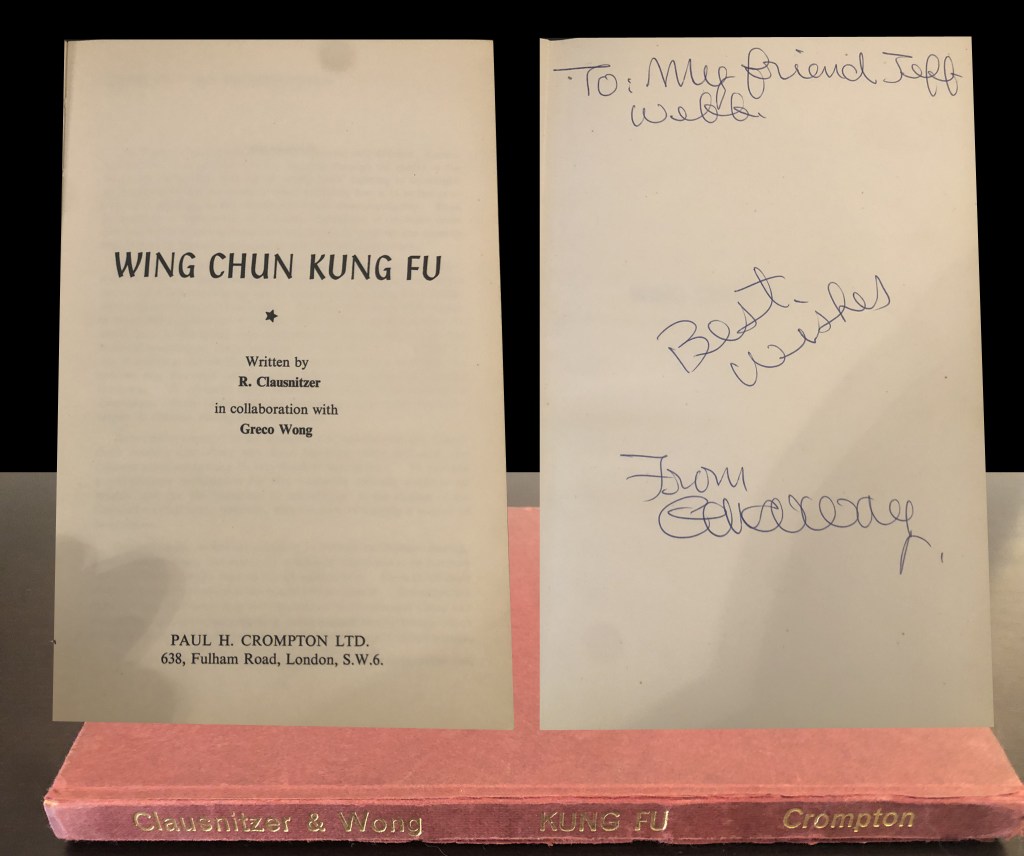
The first book on Wing Chun Kung Fu in the English language, co-authored by Sifu Greco Wong. (Published in 1969 by Paul H. Crompton, Ltd.)
An important aspect of any culture, and the martial arts in particular, is that of respect. Respect for others, for their property, for their right to their own opinions, and also respect for oneself.
It has really surprised me how over the last 10 years, the concept of respect has become lost on many Americans and especially in the martial arts community. For me personally, what shapes my perception of a person the most is not their background, nor the color of their skin, nor their bank account, nor their ability to perform dazzling feats of athleticism; instead it is whether or not they are respectful and courteous to others.
I’ve met many talented martial artists in my 39 year career. But as I discussed in my book The Broken Rice Bowl, unfortunately some were absolutely horrible people despite having achieved a high level of physical skill. For some reason, they seemed to have forgotten the lessons they learned (or should have been taught…) when they were beginners.
Being respectful and courteous costs nothing, but counts for everything.
Well almost 20 years ago, I had the opportunity to meet another well-known Wing Chun master and by showing him the proper courtesy and respect, it reflected well upon myself and on my own Si-Fu.
Back in 2005, I began teaching seminars in Calgary, Canada and by good fortune made contact with a gentleman named Greco Wong (Wong Cheung).
Sifu Wong had trained Wing Chun in Hong Kong during the 1950’s and 60’s. While initially learning under Sifu Moy Yat, he later went on to study with Sifu Mak Po, Sifu Tsui Sheung Tin and ultimately with Grandmaster Yip Man himself. Years later, he moved to England where he co-authored the first English language book on the art in 1969.
Having owned a copy of this very rare book, I took it with me to our first meeting in hopes of him signing it. The meeting took place over coffee at a Tim Horton’s Restaurant in Calgary.
Upon meeting Sifu Wong, I thanked him for his time and offered to pay for his coffee. What followed was a thoroughly enjoyable chat with a true gentleman. Though my own Si-Fu, Grandmaster Leung Ting, had studied directly with Grandmaster Yip Man during the late 60’s; Sifu Wong had insights from a much earlier period of Wing Chun’s development in Hong Kong. For a lifelong practitioner of the art like myself, Sifu Wong’s stories, experiences, and anecdotes were a goldmine of information. The discussion was a rare educational opportunity for which I was very grateful.
Towards the end of our conversation, we exchanged business cards and did so in the traditional Chinese way:
The card is always taken from a shirt or coat pocket (never from a wallet out of one’s hip pocket).
It is presented with both hands and oriented so the receiver can read it.
The receiver takes it with both hands, reads it, and then places it in their own shirt/coat pocket.
After this, I produced the copy of Sifu Wong’s book, entitled Wing Chun Kung Fu, and asked if he would kindly autograph it for me. Clearly reminiscing, he took the book from me and smiled as he said “of course!”
When he handed the book back to me, Sifu Wong said, “I’ve heard of your Si-Fu [Leung Ting] but have never met him. What is clear however, is that he teaches his pupils proper manners, and I respect that.” Upon hearing this, I remember feeling a great sense of pride. Not just for my own actions, but that I had also brought credit to my own teacher.
This became the first of many visits with Sifu Greco Wong and each was equally enlightening. One of the last times I saw him was in 2007 when he was retiring from his day job. To celebrate, I and my Calgary-based assistant took him out for a sushi dinner where I presented him with a traditional red packet. Sifu Wong was noticeably moved and thanked me. Before departing, Sifu Wong invited both my assistant and I to meet him for Dim Sum, his treat, when I was to come back into town. Several months later, we did join him for the meal – which was also a very enjoyable event.
In closing, the lesson to be learned is that being respectful and courteous costs nothing, but counts for everything. By showing genuine respect to Sifu Wong upon our first meeting, I was granted many such meetings afterwards and developed a friendship which was both rewarding and educational to me.
Aim small, miss small. Students will only achieve what you expect of them.
In the two disciplines that I teach, martial arts and firearms, I’ve encountered both good and bad teachers over the years. When I myself became a young teacher many years ago, I tried to emulate those teachers that I had met who consistently produced skilled practitioners under their tutelage.
Early on, one thing I noticed is that these teachers possessed two particular qualities. First, they had a sincere interest in seeing each of their students excel. These teachers were like artists, genuinely desiring to produce a masterpiece from each and every student. Second, because of their own high expectations upon themselves, they held their students to a similarly high standard. They expected great results from their students and that is typically what they got.
Everyone that is a skilled practitioner today, in any field of study, was at one time a total beginner. They knew nothing of the subject matter, had no skill, no experience and were unsure of what expectations would be placed upon them.
It was the experienced instructor or coach, who knew what could be achieved, how to motivate them, and how hard to push them, that brought out their true potential. For this reason, I believe it is important to expect the best from one’s students from their very first lesson. It not only sets a high standard, it sets them up to succeed.
For the purposes of this blog post, it is easier to illustrate this principle as related to firearms than to martial arts.
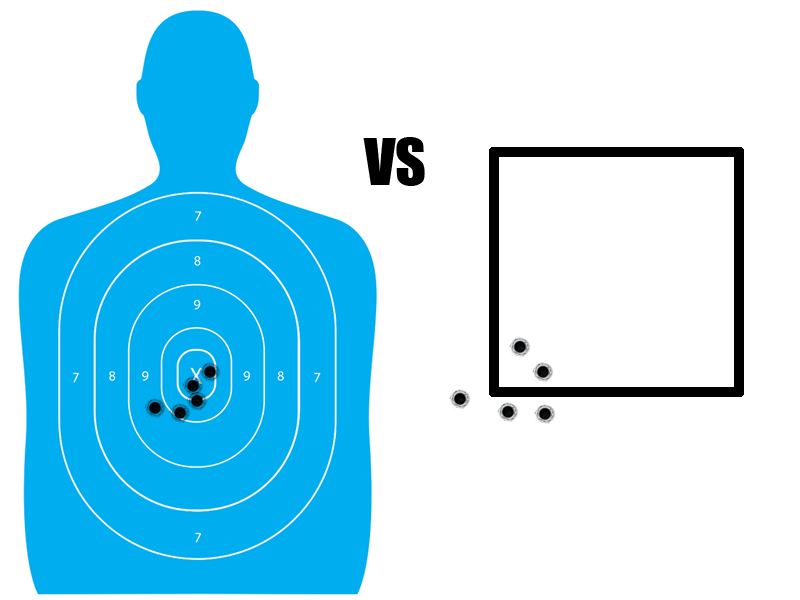
At the gun range, I’ve routinely watched another instructor teaching his students who prefers not to use a bulls-eye target. Instead, he turns the target over and draws a large 8″ x 8″ square on the back of it. He then tells his students, “don’t worry about hitting the bulls-eye, just try to get your shots inside the square.”
The first time I saw this, I must admit that I thought he was joking. Coming from a military background, the phrase we most often heard when training in firearms was, “aim small, miss small.” If the expectation is that you will hit a 2″ bulls-eye you and focus on achieving that, you’ll typically come pretty close when shooting at close range. It has been my experience that most beginners who attempt to shoot a handgun at 3 yards can easily hit the bulls-eye within their first lesson. Often, most of their early shots are only 3″-5″ away from bulls-eye in the first place.
The results I have seen when the target area is 64 square inches (8″ x 8″) are dramatically different. Not only do very few shots even make it inside of the square, they are typically nowhere near the middle of the box. By setting an extremely low expectation, the students are guaranteed to perform poorly. When I see this, all I can do is cringe.
In conclusion, the human being is an incredible creation and is capable of extremely high levels of physical and intellectual achievement. Each of us can accomplish the unimaginable, but only if we surround ourselves with others who expect the best, and ultimately if we expect the best from ourselves.
Qualified: fitted (as by training or experience) for a given purpose: COMPETENT.
Outlier: a value or point that differs substantially from the rest of the data.
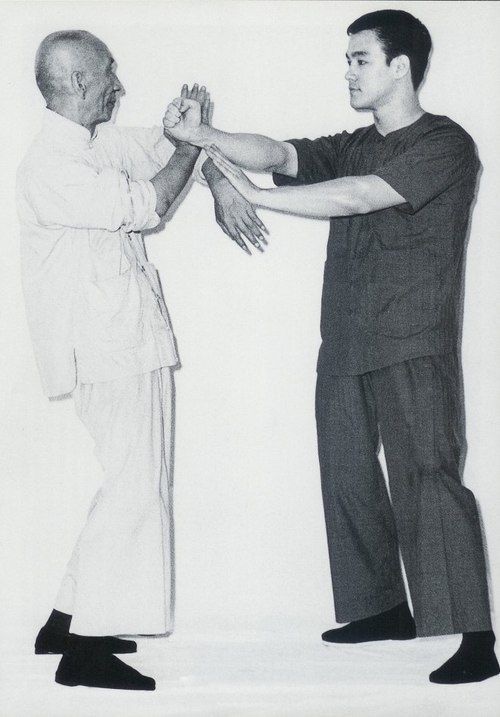
Grandmaster Yip Man and Bruce Lee
In the context of the martial arts a Qualified Outlier is a practitioner whose level of skill is substantially higher than the statistical norm, or more specifically, the majority of their peers. When we think of who might best fit this description one of the first names that comes up is Bruce Lee.
While he was only 5’7″ tall and weighed around 140 lbs., he was physically one of the strongest people ever to walk the Earth. Having learned Wing Chun kungfu for only about 3 years as a teenager in Hong Kong, he certainly wasn’t the most knowledgeable exponent of the art. However through his motivation, drive, and extremely intense training ethic, he grew into a man with skills far superior to most of his seniors under Grandmaster Yip Man.
What made him a Qualified Outlier in the martial arts, was the level of personal excellence he exhibited in not one, but many of the aspects required to be a great martial artist. Among these were strength, speed, reflexes, timing, and a sense of distance. Naturally, while many of us may excel in one of these areas or another, Bruce excelled at them all.
So what does it take the average martial artist to become a qualified outlier in their own school, art, organization, state or even country?
Undoubtedly, Bruce Lee was a phenomenal individual who was blessed genetically in many ways. But those things not withstanding, it was the intensity with which he chose to train that made him legendary.
In chapter three of my book, The Empty Cup, I discuss the concept of repetition vs. time. Take any two individuals who enroll in martial arts and continue for a full year. The one who trains consistently, never misses class, and puts in practice time at home will undoubtedly develop an appreciable level of skill. But the other student, who was enrolled for the same period of time but trained less and performed fewer repetitions, will have little to show for it.
In much the same way, if one wishes to see a demonstrable increase in skill and pull ahead of their peers, the solution is simple: put in more repetitions.
Throughout your martial arts career, you will reach plateaus; periods where skill development will level off for a while. This can be especially frustrating when it comes after a lengthy period of consistent gains and improvements. I myself have encountered a number of these over the years.
The best advice I ever got on moving past these plateaus was from my former teacher, Grandmaster Leung Ting. He said that plateaus were a normal part of the training process and not to be discouraged. Plateaus, he explained, were a good thing. It means you’re on the verge of a major jump in skill. Just be patient, keep training, and you’ll experience a break through.
His advice was 100% correct. At each time in my career where I reached a plateau, it was temporary, provided I maintained or increased my training regimen. But the opposite is also true, and I’ve seen plateaus become permanent when students decide to throw in the towel. Some scaled back their intensity and never broke through. Others sadly, figured they were at the end of the road and dropped out altogether.
As I have always said, the martial arts are a truly egalitarian endeavor. Given good instruction and coaching from a qualified teacher, the only thing stopping you from becoming a Qualified Outlier is yourself.
A few weeks ago I celebrated my 50th birthday! As a lifelong martial artist, I am still in excellent health and have managed to improve my strength, flexibility and speed over the years. Sure, there have been some physical changes, but in general I have always thought of myself as being a 30-something. I’ve never really felt “old,” or at least I never THOUGHT of myself as old.
Thankfully, I am definitely more skillful and MUCH wiser than I was in my 30’s. Since then I’ve learned, progressed, and mastered my chosen art; developing an appreciable level of skill which is commensurate for someone at my stage. I’m happy with that, yet always excited to make even greater gains.
That being said, in line with The Empty Cup mindset, I have set about planning some new goals for my life, career and training. Being fairly optimistic, I’ve been considering the next 25 years that lie ahead and what I would like to achieve in that time.
Then it suddenly dawned on me that most of my teachers, mentors and even my own parents are around 25 years older than I am right now. Where were they career-wise when they were 50? What was going on in their lives? What changes have I seen them go through in the past 25 years? What challenges did they encounter, and how did they overcome them?
I met my former teacher, Grandmaster Leung Ting, when he was just 39 years old – eleven years younger than I am now. I met my mentor, kungfu brother, and friend, Grandmaster Keith Kernspecht when he was 47; only a few years younger than my current age. Then you have the great Bruce Lee, who died when he was only 33 years old, and I’ve lived 27 years longer than that. Plus I’ve practiced Wing Chun kungfu for two years longer than Bruce Lee was even alive..!
Wow. Suddenly, turning 50 began to “feel” older psychologically than it did physically. I have to admit that cognitively, there has been a shift in my own perceptions of myself.
So where do I go from here?
Well, as I now look at those teachers and mentors who have shaped my life, I can see that each has continued to excel and succeed because they continued to embody The Empty Cup mindset.
Each has continued to improve their own knowledge, skills, and teaching ability over the years. All of them have continued to set even bigger goals, achieved them, and repeated the process. On top of that, each has contributed more to the development of their martial art in that past 25 years than they did when they were under the age of 50.
That’s inspiring to consider and it is a path I too choose to follow. While I now perceive myself differently than I did just a few months ago, it has given me greater motivation to pursue my new goals in earnest. What’s 50? It’s just a number…a big number…but just a number. 8^)
Ask any experienced martial arts instructor and they will agree: “when a student loses momentum in their training, it can be very difficult for them to regain it.”
In the shadow of Covid-19, one of the hardest hit sectors of our economy has been gyms, dance studios, and of course martial arts schools. These businesses were severely restricted from offering the very person-to-person interaction which lies at the heart of what they provide. Shifting to online lessons was only a stopgap measure, never a long-term solution. Thus, while many students adapted to online training via YouTube and Zoom, and subsequently returned to class following the re-opening, others lost momentum and fell by the wayside.
Over my years as a teacher I’ve seen people miss a class or two on occasion, which is common, and return to training with no problems whatsoever. But when they miss a couple of weeks, let alone six or more, some might never get back into the routine and may ultimately end up dropping out. Granted, this is different from person to person, but it is strongly contingent upon their mindset.
Those who have trained in martial arts longer, have typically developed a strongermindset than the average beginner. They are more self-disciplined, dedicated, focused, and mentally resilient from their martial arts training. When life events force them off track, they quickly get back on. They roll with the punches and never lose sight of the big picture.
It has been said that it takes only 30 days to change a habit or routine. This process can be challenging when you are trying to implement a new training regimen, increase your workouts, change an eating plan, or kick a bad habit. Unfortunately, it takes very little effort to lose a good habit, especially when the change only requires you to sit at home and binge watch Netflix or Hulu.
Early on during the shutdown, the mettle of many a martial arts student was tested and revealed.
Those with very little self-discipline or resolve were the first to drop out of training. You see, there are always excuses to take the easy path or to give up on a long-term goal. It can be a real struggle for some people! Sadly the ones who need self-discipline the most, are the ones who feel a sense of relief when life gives them an easy out.
Still, there are others with years of training under their belts who faced different challenges. Some might have reached plateaus in their training, or experienced turmoil in their personal lives. Already being “on the ropes,” to use boxing parlance, Covid-19 knocked them to the canvas.
In either case, the hard truth is that history always lauds those who persevere and society always admires those who don’t give up. Greatness is never achieved through surrender.
If reading that last paragraph stings, you may be at a crossroads in your life. Deep down you may have already given up, or at the very least have one foot out the door. Your choices are simple: a) Do Nothing; or b) Get Back in the Fight.
Personally, I hope you choose to get back in the fight, and to do so immediately. The longer you wait, the less likely you ever will. As I mentioned in The Empty Cup, I’ve never seen anyone who regretted sticking with their training. But I have seen many who, years later, really regretted having quit. The choice is yours…
I am happy to announce that the audiobook version of The Empty Cup is now available on Audible! Within the next few days you will also find it on iTunes and Amazon. To learn more, check out the link below:
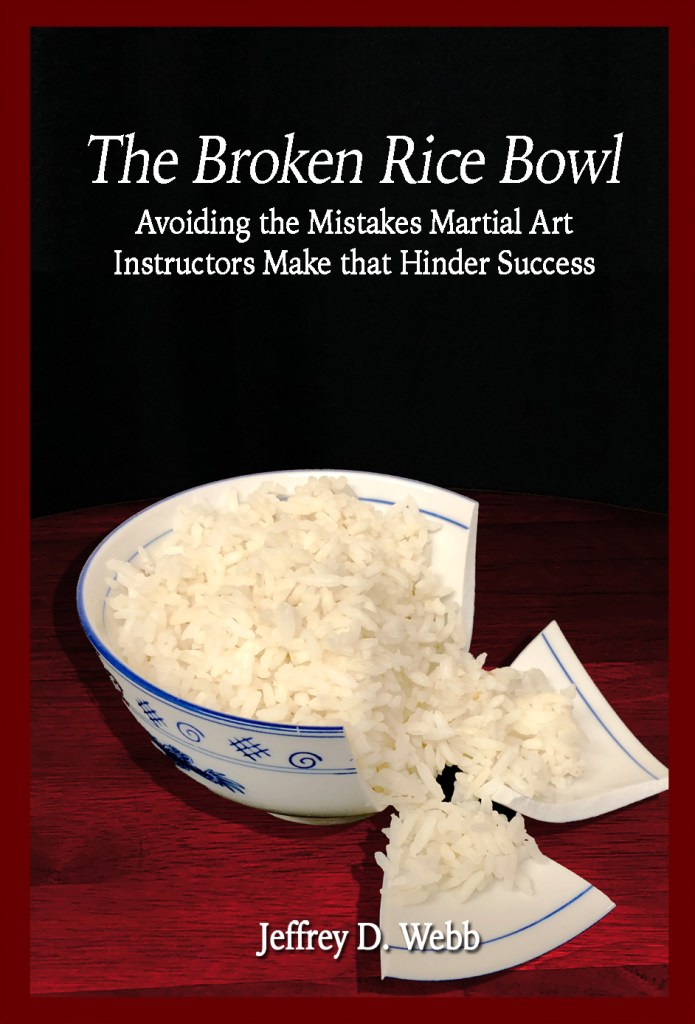
Also, The Broken Rice Bowl, the long-awaited sequel to The Empty Cup has been completed! Written with the martial arts instructor in mind, it outlines the key mistakes that instructors make that hinder their success.
At present it has been sent to a select group of reviewers and should be available on Amazon by the beginning of July. Be sure to look for it!

 The Empty Cup